
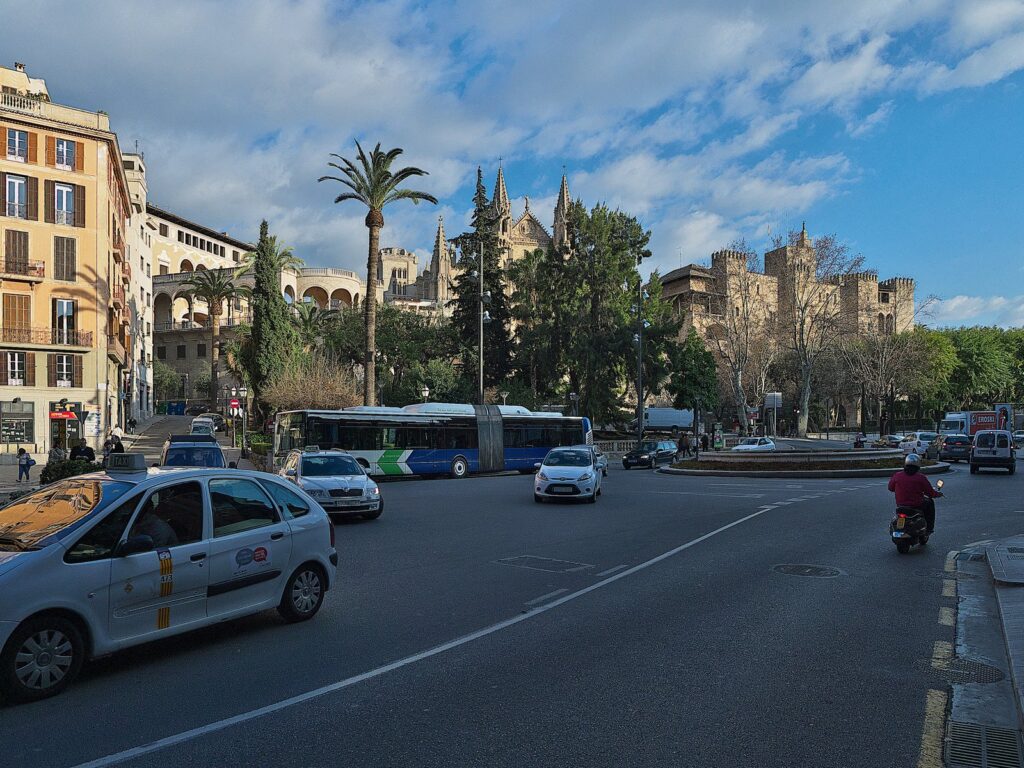
Palma’s Casc Antic — the Old Town — is compact enough to walk in a half day and rich enough to fill a week. Stone lanes, cathedral towers, quiet courtyards and a waterfront promenade sit within a few minutes of each other. This route links the main landmarks without rushing: La Seu, the Palau de l’Almudaina, the Banys Àrabs, the Call (historic Jewish quarter), Parc de la Mar, then the lanes that lead toward Passeig del Born and La Lonja.
It suits curious walkers, first-time visitors and anyone who prefers atmosphere over a checklist. Comfortable shoes matter — surfaces are uneven, and there are gentle climbs near the cathedral. Families will manage if you keep the pace loose; pushchairs are possible on the wider streets but awkward in the narrowest alleys.
Check official sites for opening times and tickets before you go. Hours change by season and for religious services.
Palma Cathedral and Old Town tour on Klook. See our affiliate disclosure for how partner links work.
Photo: Jl FilpoC / Wikimedia Commons (CC BY-SA 4.0)
Who it suits
- First visit — a clear loop that orients you to the historic centre.
- Culture and architecture — Gothic cathedral, royal palace, Arab baths, medieval lanes.
- Half-day pace — roughly three to five hours with café stops; shorter if you skip interiors.
- Less ideal if you want beaches or nightlife as the main focus (those come later, or on another day).
Suggested pacing (half day)
Aim for a late morning start so façades are lit and cafés are open, or a cooler late afternoon in summer. Build in time to sit — Parc de la Mar and the Born are natural pause points.
| Segment | Rough feel |
|---|---|
| La Seu & Palau de l’Almudaina | 45–90 min (exterior + optional interiors) |
| Banys Àrabs & Call | 45–60 min |
| Parc de la Mar / waterfront | 20–40 min |
| Toward Born & La Lonja | 30–60 min |
Treat timings as a guide, not a schedule. Queues and services can change the day.
The walk
Start at La Seu (Catedral de Mallorca)
The cathedral — universally called La Seu — dominates Palma’s skyline and the bay. Approach from the sea side if you can: the apse and flying buttresses rise above the old walls and Parc de la Mar. From the city side, the main façade and portal are equally striking.
Notice the scale of the nave (one of the tallest Gothic interiors in Europe), the rose window when light allows, and Gaudí’s early-20th-century interventions inside. The chapter house and museum spaces are worth it if you like ecclesiastical art — but only if you have booked or checked tickets and opening times on the official cathedral site.
Step outside again before moving on. The terrace and Mirador viewpoints overlooking the bay are part of the experience even if you skip the paid interior.
For interiors and any timed entry, use the official cathedral site only — hours and ticket types change with seasons and services.
Palau de l’Almudaina
Beside La Seu sits the Palau de l’Almudaina, the former Muslim alcázar later adapted as a royal palace. From the outside you see a blend of fortification and later façades; inside (when open to visitors), state rooms and courtyards tell the story of Christian Mallorca after the conquest.
Even a walk around the perimeter is worthwhile: the relationship between cathedral, palace and sea wall explains why Palma’s power was concentrated here. Confirm visiting arrangements on the official Patrimonio Nacional (or current palace) pages — do not rely on third-party summaries for hours.
Banys Àrabs
A short walk inland through shaded streets brings you to the Banys Àrabs (Arab Baths), one of the few surviving fragments of Medina Mayurqa. The dome with star-shaped openings and the garden setting are modest in size but memorable. It is a quiet counterpoint after the cathedral’s grandeur.
Access and hours are managed locally — check current details before you queue, and expect a small site rather than a sprawling complex.
The Call (historic Jewish quarter)
Palma’s Call — the historic Jewish quarter — lies in the web of streets between the cathedral area and what is now Carrer de la Portella and surrounding lanes. Look for narrow passages, stone arches, and plaques that mark the former community’s presence. The Call is best experienced slowly: peek into courtyards where gates are open, notice the change in street width, and use a good map so you do not circle the same block twice.
There is no single “ticketed” Call experience; it is a neighbourhood to read as you walk. Respect residential quiet and private doorways.
Parc de la Mar and the waterfront
Drop back down to Parc de la Mar, the landscaped strip between the cathedral walls and the sea. The artificial lake mirrors La Seu on calm days — a classic Palma photograph. Benches, shade and the breeze off the bay make this the natural halfway pause.
From here the waterfront path links toward the harbour and the western edge of the Old Town. Watch for the old sea walls and the sense of the city opening to the Mediterranean.
Lanes toward Passeig del Born and La Lonja
Continue west through the lattice of streets that lead to Passeig del Born — Palma’s elegant tree-lined boulevard — and on toward La Lonja (also known as Sa Llotja), the late-Gothic former merchants’ exchange by the water. The Born is for people-watching and a coffee; La Lonja’s exterior alone is worth the detour, with its sculpted gargoyles and fortress-like presence.
If energy remains, wander the nearby lanes of the old merchants’ quarter rather than racing onward. This is where Casc Antic feels lived-in: bakeries, small plazas, and sudden views of tower and sea.
When you want a food-led evening after the walk, drift west toward Santa Catalina rather than defaulting to the busiest cathedral approaches — see our Santa Catalina neighbourhood guide and What to eat in Palma.
What to notice
- Light on stone — morning and late afternoon change the colour of façades around La Seu.
- Layered history — Arab baths, Jewish quarter, Gothic cathedral and royal palace within a few hundred metres.
- Sea and city — Parc de la Mar makes the relationship explicit; do not skip the waterfront.
- Street names — Catalan forms (Carrer, Plaça, Passeig) are standard; Spanish equivalents appear on some signs and maps.
- Shade and heat — in summer, plan interiors or café breaks for the hottest hours.
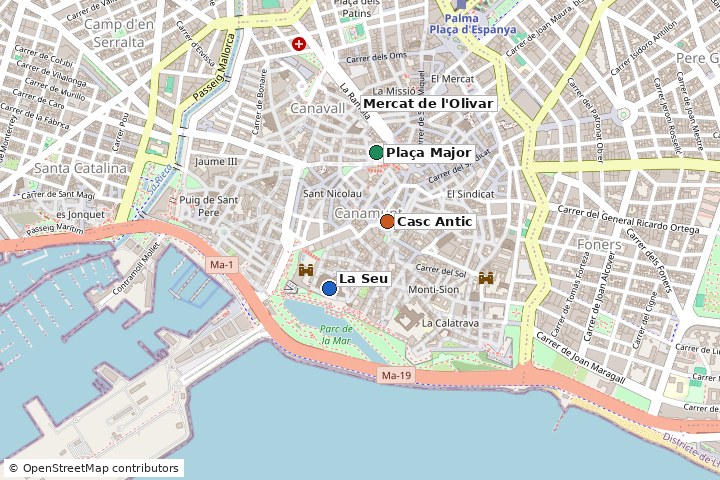
Practical notes
- Tickets & times — La Seu, Palau de l’Almudaina and the Banys Àrabs each have their own visiting rules. Always verify on official sites before you set out.
- Dress — shoulders and knees covered may be required for cathedral interiors; carry a light cover-up.
- Water & breaks — fountains are limited; carry water, especially in summer.
- Getting there — Casc Antic is walkable from central hotels and many bus stops; taxis and ride apps drop near the cathedral or Born.
- Beyond this walk — food-focused Santa Catalina sits west of the Born; the city beach at Can Pere Antoni is east along the waterfront. Sóller and the Serra de Tramuntana are better as a full day trip, not bolted onto this half-day loop.
Useful next bookings
If this walk is your first day, keep evening flexible: a quiet drink on the Born or a simple dinner nearby beats another monument. For a fuller weekend plan that mixes Casc Antic with markets, food and an optional beach stop, see the Palma in 48 hours itinerary. For circular walls and bay views west of the old town, see our Castell de Bellver guide.
Staying inside or beside the Casc Antic keeps mornings walkable for La Seu and the old-town lanes. Compare hotels near Palma Old Town. Also on Klook. See our affiliate disclosure for how partner links work.